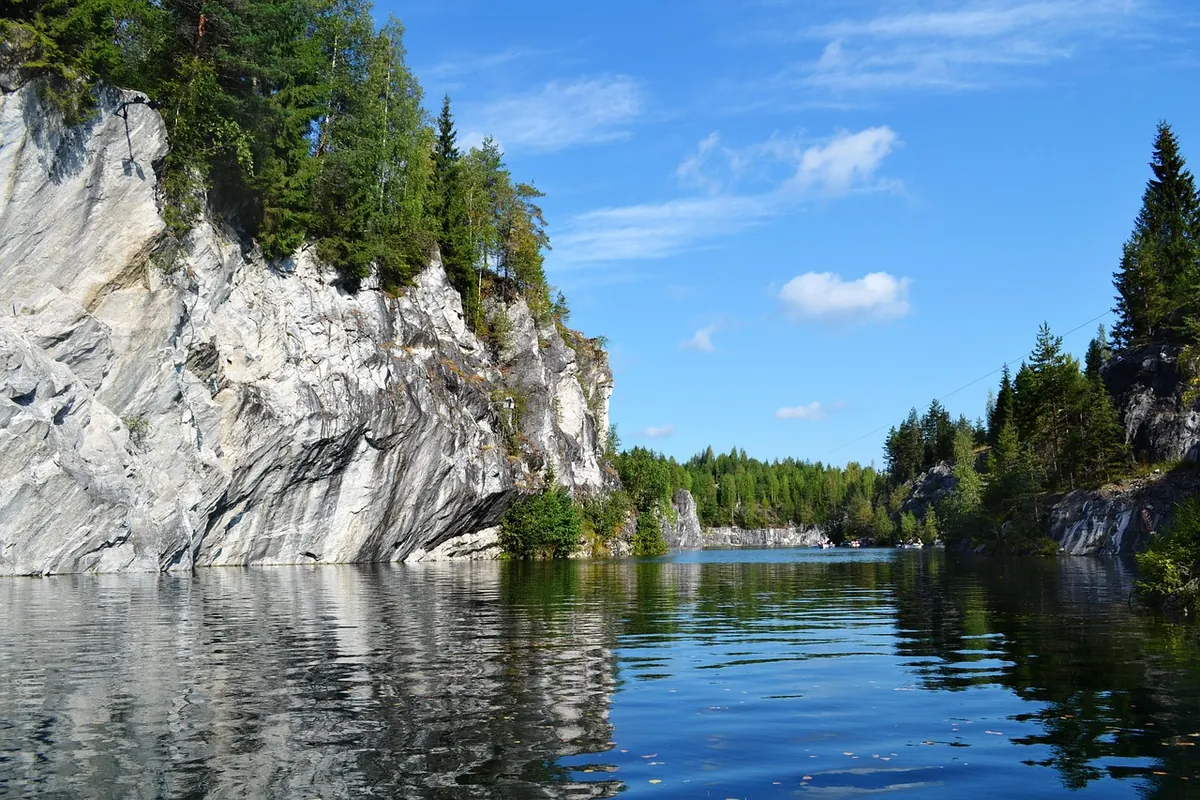
You hear Carrara before you see it. Above the noise of the coast road there is a deeper sound: the ring of a diamond wire biting into stone, and the grind of a truck carrying a block the size of a small room down the mountain. Then the slope opens and the whiteness appears — not one white but a dozen, cut into terraces that look like the steps of an unfinished temple.
Carrara is not a museum of marble. It is a working town of about sixty thousand people, and the mountain above it is a workplace first and a landscape second. That order of priorities is the single most useful thing to understand before you go up.
A Mountain That Has Always Been Worked
Marble has been taken from the Apuane Alps since Roman times, and the marks of that long extraction are everywhere: straight-cut walls, spoil heaps turning green, roads that exist only to move stone. This is not a wilderness with a quarry in it. It is a mountain shaped by centuries of demand — for temples, for palaces, for bathrooms in cities you will never visit.
Most visitors concentrate on three basins above the town: Torano, Fantiscritti and Colonnata. Each has its own character. Torano is the busiest and the most photographed, with huge benches stacked above the road. Fantiscritti is where you find the small quarry museum and the widest views back towards the sea. Colonnata sits higher, a village of quarry workers' houses where the air is cooler and the stone is greyer.
Look closely at the roadside and you will see abandoned quarry chambers — locally called cattedrali — where the cutting stopped and left vertical walls, clean corners and an accidental architecture. Some are used for concerts and events. Others just sit there, filling with water and ivy.
What Happens Inside an Active Quarry
Forget the image of a man with a chisel. Modern extraction is a remarkably precise industrial operation. A diamond wire saw runs on pulleys, slicing a vertical cut down the face of the rock; horizontal cuts follow underneath. The result is a block, usually a few cubic metres, that is then pushed over with hydraulic jacks and lowered onto a bed of rubble before being loaded onto a truck.
Everything is wet. Water cools the wire and controls the dust, which turns the whole quarry floor into a pale grey slurry. Everything is also enormous: tyres taller than a person, benches cut in steps of several metres, cables on the ground that you should never step over casually.
This is why you cannot simply drive into an active quarry. It is a construction site with blasting, falling rock and heavy machinery, and the workers have no time to watch where a visitor is standing. Book a guided visit with an authorised operator, and accept that the itinerary may change at short notice because the quarry has decided to do something else that morning.
A Short Glossary of Bianco
"Carrara marble" is a family of materials, not a single one. Knowing four or five names will make every workshop conversation easier.
- Statuario — the historic sculptor's stone: bright white ground, sparse grey veining, translucent enough to glow at the edges. Rare, and priced accordingly.
- Bianco Carrara, or bianco ordinario — the workhorse. Cool white with a fine grey-blue web, sold in grades that reflect how even the background is and how much veining it carries.
- Calacatta — a trade name now attached to several dramatically veined whites, with bold grey or warm gold lines. Not all Calacatta sold in the world comes from these basins, so ask where a specific slab was quarried.
- Arabescato — swirling, high-contrast veining that looks almost drawn. Popular for book-matched walls.
- Bardiglio — the quiet one: a fine-grained grey-blue marble that takes a polish like glass and is often used for floors and stair treads.
Ask a workshop to show you the difference between a block, a slab and a tile of the same stone. Seeing the same material at three scales explains more than any brochure.
The Culture of the Cavatori
Quarry work built a distinct local identity, and it is still visible. Older residents can describe lizzatura, the technique used until the mid-twentieth century to slide blocks down the mountain on wooden sledges, controlled by ropes, grease and men working in careful rhythm. The ropes have gone, but the vocabulary has not.
Food carries the same history. In Colonnata, lardo is cured in basins carved from local marble, a neat loop in which the mountain preserves what feeds the people who work it. Village trattorias still serve it with bread and a glass of Vermentino, and lunch is a serious business.
One etiquette note: people here are proud of the trade and tired of being photographed as though they were folklore. Ask before you point a lens at a worker, and do not treat a yard full of half-finished statues as a free sculpture park.
The Town Below the Mountain
Carrara's centre is a modest grid of streets with a startling centrepiece: a cathedral clad in local marble, its facade patterned in black-and-white bands, standing in a piazza that smells of coffee and stone dust. Around it are the workshops, many open by appointment only, where blocks become staircases, tabletops and sculpture.
The Accademia di Belle Arti has trained sculptors here for centuries, and its presence gives the town a quiet international layer — students, foundries, studios, a rhythm of residencies and open-studio weekends. If you have an afternoon, spend it here rather than ticking off another quarry. The Museo Civico del Marmo explains the extraction chain, from geology to finished product, better than any roadside panel.
The Argument You Will Hear on the Mountain
Anyone who spends a few days in Carrara will run into a dispute that is not simple. The Apuane are a regional park, home to rare flora, deep caves and water systems that supply the plain. They are also a source of livelihood for quarry families, hauliers, workshops and the port below.
Environmental groups argue that extraction has gone too far, that permits deserve scrutiny and that the mountain is a finite resource being consumed faster than it regenerates. Quarrying families argue that their work is regulated, that they live on the mountain and care what happens to it, and that outsiders romanticise a landscape they do not depend on. Both sides have a point, and neither is a caricature.
For a visitor, the practical response is curiosity rather than a verdict. Ask how a block gets from the face to the port. Ask what happens to the spoil. Ask a workshop owner where the stone for a particular slab came from. You will learn more about the industry in an hour of that than in a week of admiring showrooms.
Practical Notes for a First Visit
Two days is enough to see the town, go up the mountain and speak to someone who cuts stone. One day is enough only if you plan carefully. A sensible sequence:
- Start at the Museo Civico del Marmo in the morning to learn the terminology and the process.
- Take the quarry road up through Torano towards Fantiscritti, stopping at the small quarry museum there.
- Continue to Colonnata for lunch and a short walk through the village.
- Return to Carrara in the afternoon for workshops, the cathedral and a coffee in the piazza.
A few things to keep in mind. Wear closed shoes with grip — the dust is slippery and there is loose rubble everywhere. Bring a jacket even in summer; the basins are higher and windier than the coast. Go early, because truck traffic builds through the day and light is better for photographs before noon.
Book quarry visits in advance and expect to pay for a proper guide; this is the only responsible way inside an active site. Carry water and do not wander off a marked route to get a better shot of a cliff edge. And leave time for an unscheduled conversation. Some of the best explanations of how Carrara works come from someone leaning on a forklift, telling you why that particular block was rejected.
Photo: kseniyaegor / Pixabay