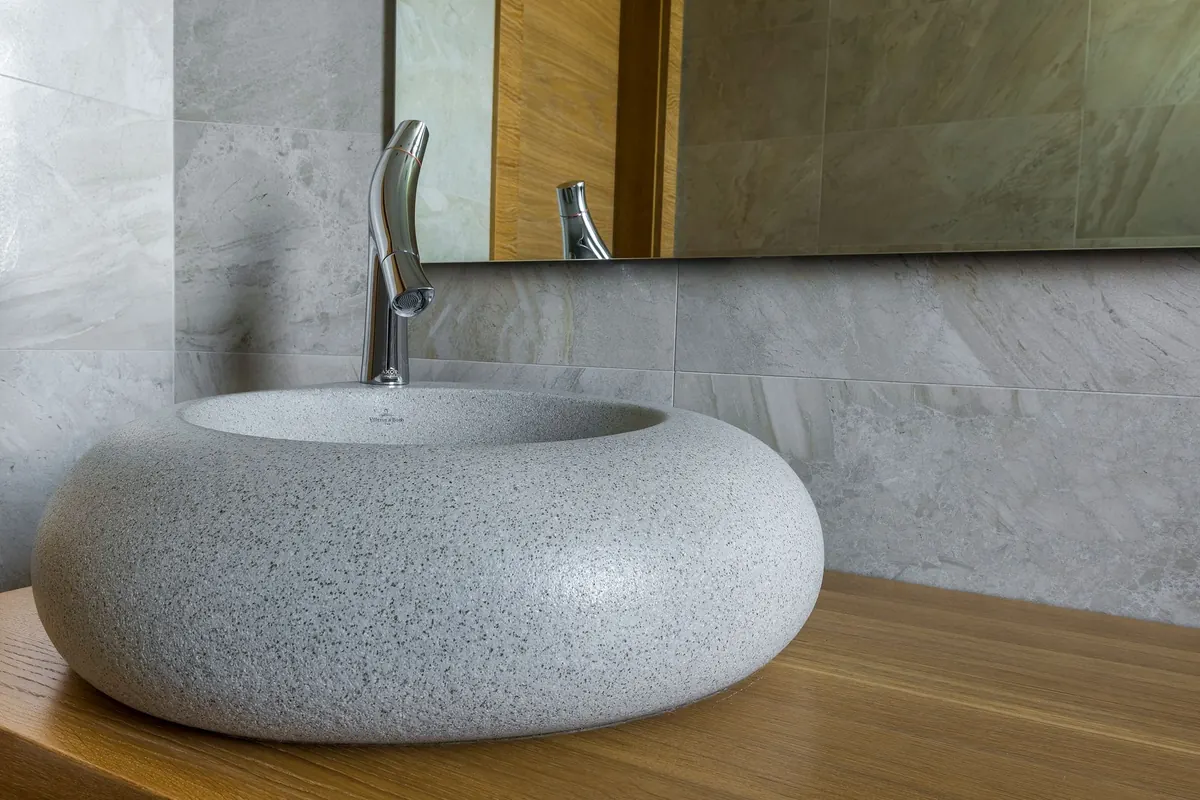
Stone in Small Spaces: 8 Design Moves That Make a Difference
A compact bathroom does not need a big idea. It needs fewer of them. Stone has a reputation as the heavyweight of the material palette — expensive, permanent, and inclined to dominate any room it enters. In a small bathroom, that reputation is mostly undeserved. Stone does not shrink a space. Indecision does. So does a slab chosen for its beauty at the yard and its drama at three in the afternoon in a room with one window.
What follows is not a mood board. It is a working list: eight moves that reliably make a small wet room feel calmer, larger, and considerably more expensive than the square footage suggests. None of them requires a bigger budget. A few of them quietly save money.
1. Commit to one stone and repeat it
The fastest way to make a small room feel cluttered is to use three materials that each want attention. Pick one stone — a honed limestone, a soft grey marble, a charcoal slate, even a terrazzo — and let it do the whole job: floor, vanity top, niche shelf, shower curb. Repetition reads as space, because the eye has nothing new to stop on.
If you want contrast, introduce it through a second material that stays quiet: brushed nickel, warm oak, a matte white ceramic basin. Three finishes maximum in a room under four square metres. Anything beyond that starts to look like a showroom rather than a bathroom.
2. Go vertical, not horizontal
A small floor covered in busy stone looks smaller, not bigger, because the pattern breaks up the one continuous surface you have. Move the stone up the wall instead. A single slab running floor to ceiling on the shower wall or behind the vanity pulls the eye upward and makes the ceiling feel higher than it is.
You do not need to clad every wall. One vertical plane is enough — and it is often cheaper than tiling the floor and walls in the same material, because you are covering less area with more impact.
3. Match the format to the room's longest line
Tile proportion does more for perceived size than tile colour. A long, narrow room wants long, narrow formats laid lengthways: a 600 × 300 or a slender plank-shaped stone, running away from the door. A square room can take a larger square or a herringbone without either looking busy.
The rule is simple and almost always true: the dominant line of the stone should echo the longest dimension of the room. Cross it and the space feels chopped. Follow it and the space feels deeper.
4. Let the veining do one thing
Dramatic stone is not the enemy of a small room; undirected drama is. If you are using a heavily veined marble, book-match it on a single feature wall and keep every other surface plain. If you are using a subtle stone, you can afford to be more generous with it.
What you cannot do is put a boldly veined floor under a boldly veined wall and expect the room to hold together. Veining is a direction. Give it one place to go.
5. Spend the stone where hands actually land
In a small bathroom, most of the stone is seen. A small amount is touched. Put the budget in the second category. The vanity top, the niche shelf, the shower threshold, the edge of the bench: these are the places where a 20 mm slab, a properly mitred edge, and a hand-finished surface register every single day.
Walls and floors can be a good porcelain that reads as stone from a metre away. Nobody has ever run a palm along a wall tile at seven in the morning and felt shortchanged by it.
6. Choose honed over polished
Polished stone is a mirror. In a small room with one light source, a mirror is a glare machine, and every water droplet becomes a headline. Honed — matte, slightly chalky — absorbs light rather than throwing it back, which makes a tight room feel softer and considerably more forgiving.
It is also safer underfoot in a wet area, and it hides the faint soap scum that polished surfaces advertise. If you love a sheen, keep it to a small splashback and hone everything else.
7. Use thickness and edges as the detail
When you cannot add objects to a small room, the architecture has to carry the interest. Stone is unusually good at this. A 30 mm waterfall edge on a floating vanity, a deep stone skirting, a shadow-gap reveal where the wall meets the floor, a slab thick enough to read as furniture rather than cladding — these are details you notice without needing anything hung on the wall.
One strong edge detail beats five decorative ones. Choose it early, because it determines how the stone is cut, and cutting is where the money goes.
8. Let stone stop short
Not every surface needs to be stone, and in a small room the discipline of stopping is what makes the material look deliberate. Run the stone to 1.2 metres up the wall, then switch to paint. Wrap the vanity in stone and leave the adjacent wall plastered. Set a stone band at eye level and let everything above it breathe.
A controlled edge line reads as confidence. Stone that simply runs out at a doorway reads as a budget that ran out first.
The moves that quietly shrink a room
Worth naming, because they are common:
- A border or mosaic band. It draws a rectangle around a small floor and makes the ceiling feel lower.
- Dark stone everywhere. Beautiful, but in a room with poor light it closes in. Keep dark stone to one plane and let the rest stay light.
- Too many grout lines. Small formats in a large field mean more joints, more visual noise, and more maintenance. Fewer, larger pieces almost always feel bigger.
- Polished floors in a shower zone. A slip risk and a glare problem at once.
- Mixing slab and tile of the same stone. The tone rarely matches, and the mismatch is the only thing you will see.
In a small room, every material decision is a spatial decision. Stone is not decoration here — it is the architecture.
Before you order: samples, sealing, and the 10 percent rule
Order a full-size sample, not a chip, and look at it in the actual room at the actual times of day you use it. Stone changes under warm evening light and cool morning light, and a small room magnifies the difference. Compare two or three candidates side by side against your fixtures, not against each other on a white table.
Then do the practical arithmetic:
- Add 10 percent to your measured area for cuts, breakage, and future repairs — 15 percent for diagonal or herringbone layouts.
- Buy from one batch. Stone varies between blocks, and in a small room a tonal shift between two boxes is glaring.
- Confirm the finish. Honed, brushed, sandblasted and polished all behave differently underfoot and under water.
- Ask about sealing. Most limestone and many marbles want it; dense granites and slates often do not. Re-seal annually in a wet zone.
- Book the fabricator before you book the tiles. Good cutting and edge work is the difference between a detail and a mistake.
None of this is glamorous. All of it is what separates a small bathroom that feels considered from one that merely feels full. Stone in a tight space is not about how much of it you can fit. It is about how little you need — and how precisely you place it.
Photo: whitedaemon / Pixabay