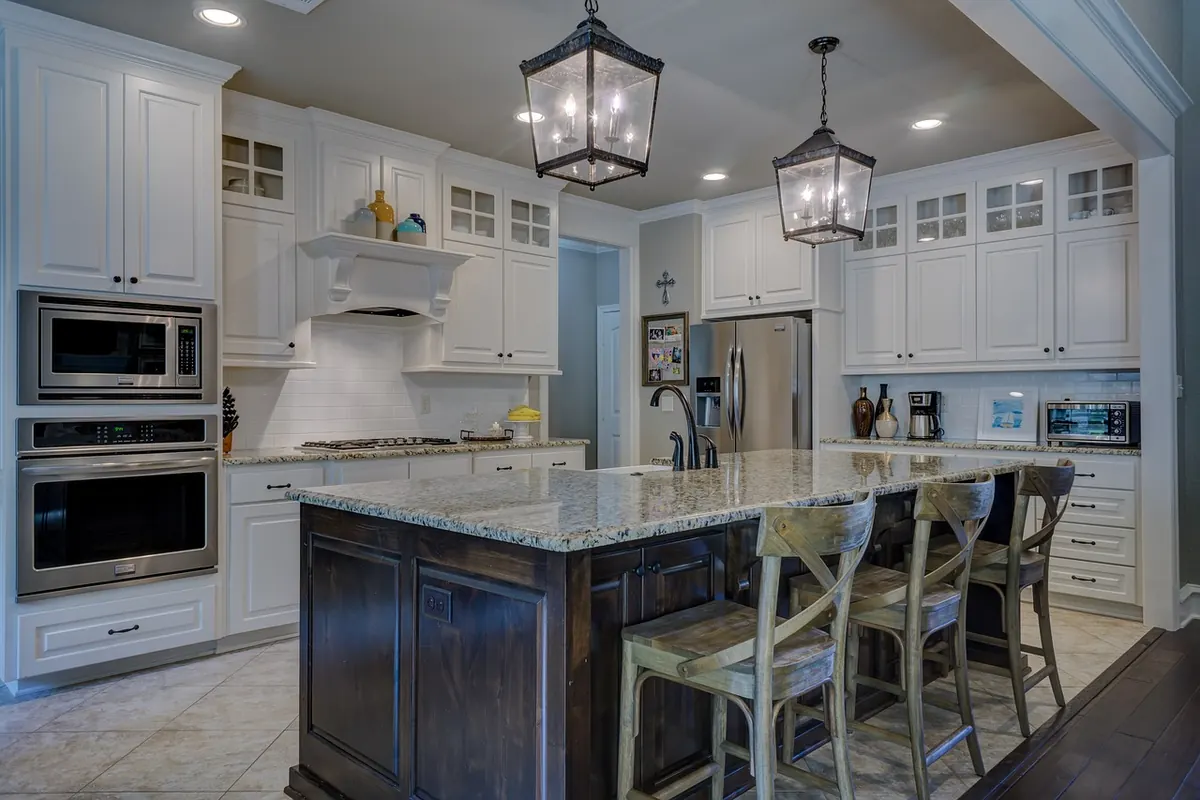
Walk into a kitchen and the island registers before anything else. What you may not consciously notice is the line where the stone stops — the edge profile. It is a detail measured in millimetres, yet it decides how the whole room reads: crisp and architectural, soft and familiar, ornate and traditional. It also shapes how the countertop feels against a hip, how well it survives a dropped pan, and how easy it is to keep clean around the sink. Here is how the four most common profiles compare in practice.
What the Edge Actually Does
An edge profile is doing three jobs at once. First, it controls the apparent thickness of the slab: a square edge on a 20 mm top looks lean and modern, while a deep ogee or a full bullnose adds visual weight. Second, it decides where the stone is vulnerable. Every profile leaves at least one arris — the line where two surfaces meet — and that line is where chips begin. Third, it sets the safety of the room. A radiused edge forgives a bumped hip; a sharp corner does not, particularly at the end of a run or the corner of an island.
One more thing worth knowing before you choose: some profiles are easier to fabricate than others, and not every material accepts every shape. Thin porcelain slabs, for instance, rarely take a deep ogee, and the profile has to be cut and polished with the right tooling. Ask what your fabricator can execute in your specific slab rather than assuming the catalogue applies.
Square and Eased Edges
The square edge is the default of contemporary stone design, and for good reason. A straight 90-degree cut, polished on the face, gives a clean shadow line and lets the slab speak without ornament. On a waterfall island it looks almost seamless. Pair it with handleless cabinetry, large-format flooring and a slab with strong movement, and the profile disappears exactly as intended.
The case for a small easing
A truly sharp square edge is unforgiving. The top arris chips if a cast-iron pan lands badly, and the corner of an island becomes a genuine hazard in a busy household. Most fabricators therefore ease the edge by a millimetre or two — enough to blunt the bite while keeping the line reading as square. Ask for this explicitly, and specify the size. A 2 mm ease is invisible from standing height; a 5 mm round starts to look like a small bullnose.
Best for: modern, minimalist and industrial kitchens; thin slabs; waterfall islands; anyone who wants the stone to look like a cut block. Watch out for: sharp outside corners, and exposed edges beside walkways.
Bullnose: Full and Half
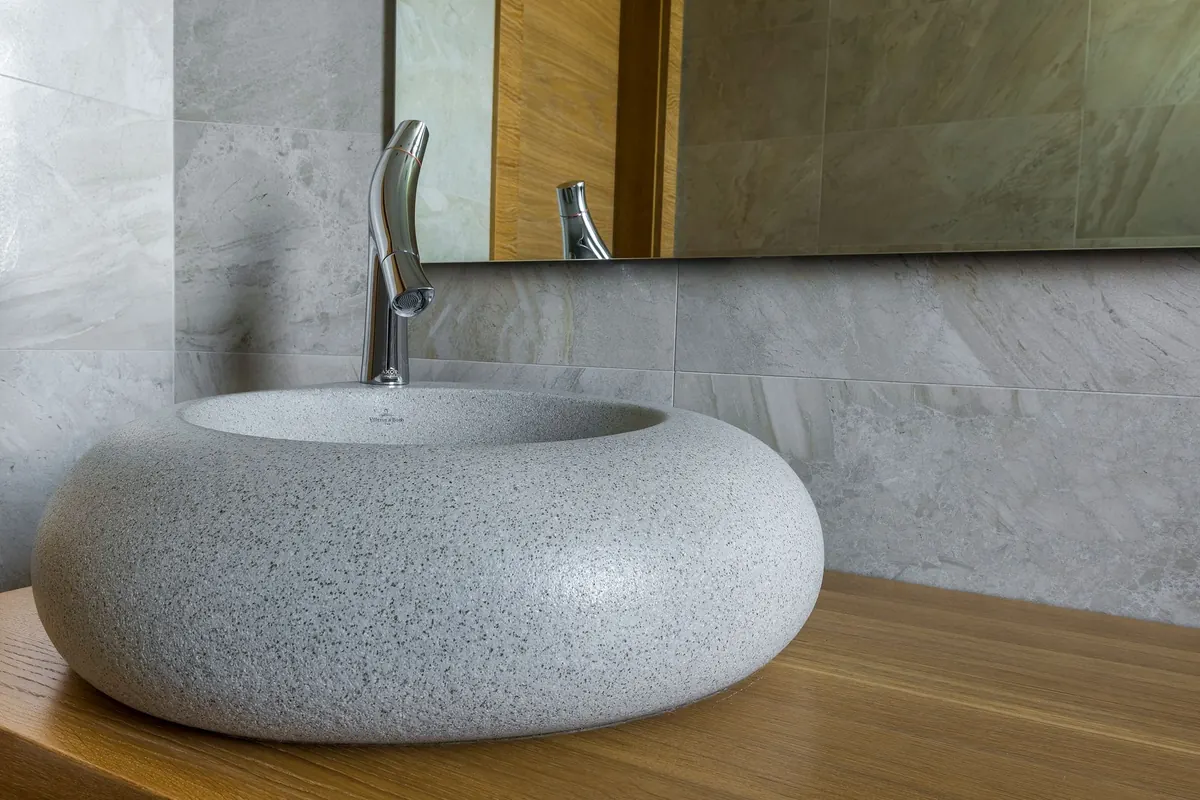
Bullnose is the rounded profile, and it comes in two useful versions. A full bullnose is a semicircle whose radius equals half the slab thickness, so the edge reads as a smooth, continuous roll from top to bottom. A half bullnose is a quarter-round that softens only the upper edge and leaves a short vertical face below.
This is the most forgiving profile in a family kitchen. There is no point to catch a hip, no arris to chip on the leading edge, and nothing to snag a cloth. It also feels good under the hand — a quality people notice at a breakfast bar without being able to name.
The trade-off is stylistic. Full bullnose carries a softer, slightly traditional note, and on a 30 mm slab it can look heavy. It also hides less than you might hope: the rounded face catches light and shows scuffs and dull polishing more readily than a flat one, and repairing a chip on a curve takes more skill than repairing a flat edge.
Best for: family homes, breakfast bars, traditional and transitional kitchens, and anyone prioritising safety. Watch out for: the dated look a heavy full bullnose can give a very modern room.
Bevel
A bevel is an angled cut — usually 45 degrees — that meets the top surface and then returns to a vertical face. Depending on the size, it reads either as a subtle chamfer or as a pronounced architectural chamfer with a distinct shadow line. It is the profile that best bridges modern and traditional rooms: crisp enough for a contemporary kitchen, crafted enough for a period one.
Bevels are good at deflecting damage. The angled face takes knocks obliquely rather than directly, so the vulnerable corner is spread over a wider band of stone. The weak point moves to the lower arris, where the bevel meets the vertical face; keep an eye on that line near doorways and dishwashers.
Sizing matters more than with any other profile. A small 6–10 mm bevel is almost a stylistic whisper. A 25–40 mm bevel becomes a design feature and needs a slab thick enough to support it without looking thin from the side.
Best for: transitional kitchens, islands with a strong geometric line, homeowners who want visual interest without fuss. Watch out for: a bevel so large that it thins the visible edge of the slab.
Ogee
The ogee is the S-curve: a convex roll flowing into a concave cove, often finished with a small fillet. It is the most decorative of the four and the most demanding to execute well. In the right room — a traditional kitchen with panelled cabinetry, a farmhouse sink, dark polished granite or a richly veined marble — it looks deliberate and generous. In a flat-fronted modern kitchen it looks like a transplant.
Functionally, an ogee is a mixed bag. The curves are comfortable to lean against, but the concave section is a shelf for crumbs and flour, especially along a run beside the hob. A soft brush and a microfibre cloth once a week keeps it in order; a quick wipe will not. The deep undercut is also the profile's structural weakness — the thin lip at the bottom is the first place to chip, and it cannot be sanded back without reshaping the whole profile.
Thickness is non-negotiable here. An ogee needs material to carve, so it belongs on a 30 mm or thicker top. Attempting it on a thin slab leaves a profile that looks pinched rather than sculpted.
Best for: traditional and classic kitchens, statement islands, thick slabs. Watch out for: cleaning in the cove, and chipping on the lower lip.
The Four Profiles Side by Side
- Square / eased: sharpest look, lightest visual weight, most exposed to chipping at the arris. Choose the eased version for daily life.
- Bullnose: softest and safest, strongest family credentials, best on thicker slabs, hardest to touch up invisibly.
- Bevel: the most versatile, good chip resistance, sensitive to size and slab thickness.
- Ogee: the most decorative, the most maintenance, requires thickness and a traditional setting to earn its place.
Ask your fabricator for a physical offcut of the profile cut in your actual slab, not a plastic sample chip. Stone colour changes how a curve or chamfer reads under kitchen light.
How to Choose With Confidence
- Judge it in the room. A profile looks different on a 3 m island than on a sample board. Hold the offcut against the cabinets at eye level and from where you will actually stand.
- Look at the corners first. The profile matters most at outside corners and at the sink and hob cutouts. Ask how those will be finished, because they often differ from the main run.
- Match the material. Confirm the profile is achievable in your slab thickness and stone type, and ask whether it affects the warranty or the seam layout.
- Think about the household. Small children, frequent cooks and anyone with limited mobility all argue for a radiused or eased edge over a crisp square one.
- Budget the maintenance. Every profile needs polishing eventually. Ask what re-polishing involves for the shape you choose, and how visible the repair would be.
There is no single correct edge. A square with a whisper of easing will make a modern kitchen look sharper and more expensive; a half bullnose will keep a family kitchen kinder for a decade; a bevel quietly flatters almost any room; an ogee earns its ornament only in the right company. Decide what the room should feel like, then let the last two centimetres of stone say it.
Photo: shadowfirearts / Pixabay